
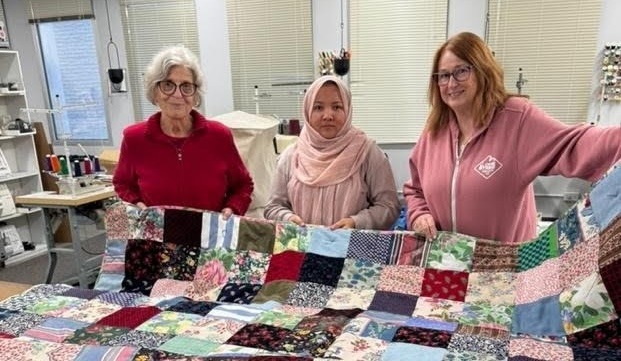
Like many older adults who move from their home with a collection of saved memories, I found myself being given a strong suggestion by my son about a large pile of clothes and linens of my mother’s. Peter’s love of his grandmother is real and important, like all her grandchildren, but he felt I had no room for all these treasures as I moved to a much smaller house. I had to find a solution.
I work one floor above The African Community Center and their amazing sewing program, We Made This, for refugee women. I went downstairs and talked to Amber, the Program Coordinator, who works with Tahira, a member, and Mary Jane, a volunteer. Tahira was eager to learn how to make a quilt; Mary Jane has lots of experience. What transpired was more than I could have ever imagined. I brought some of my mother’s clothes, napkins, tablecloths and pieces of upholstery. We talked about the size and other needs. Everyone was very kind and the quilt began to appear.
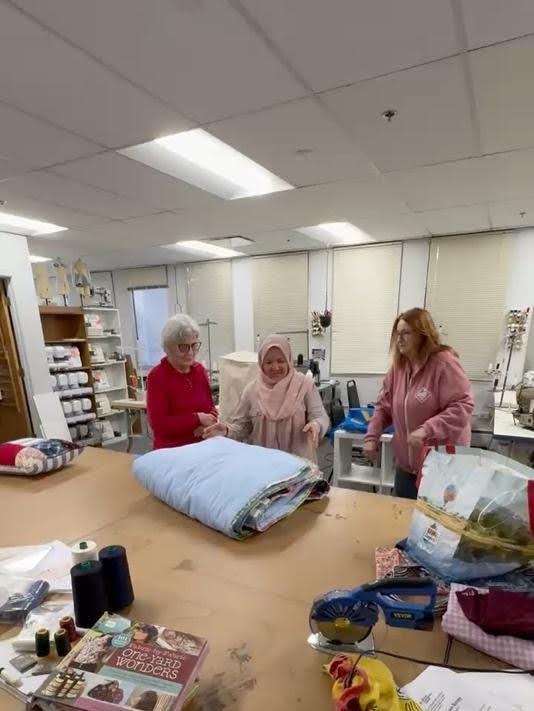
Over the next four months, Tahira, who has 3 young children and another one on the way, and Mary Jane, a busy grandma, hobbyist, and volunteer at We Made This, worked steadily. We met several times and they even came to my house to make sure of the measurements. I was excited and my first view of the quilt was amazing, but nothing compares to how it all turned out.
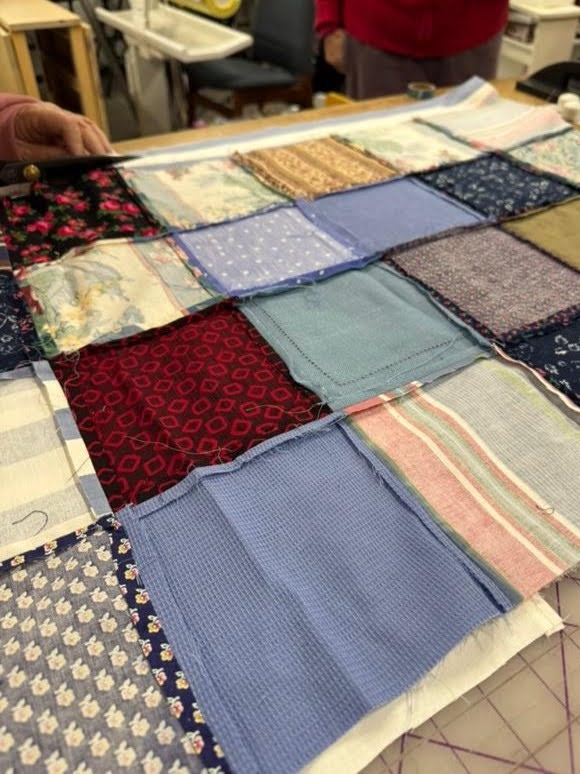
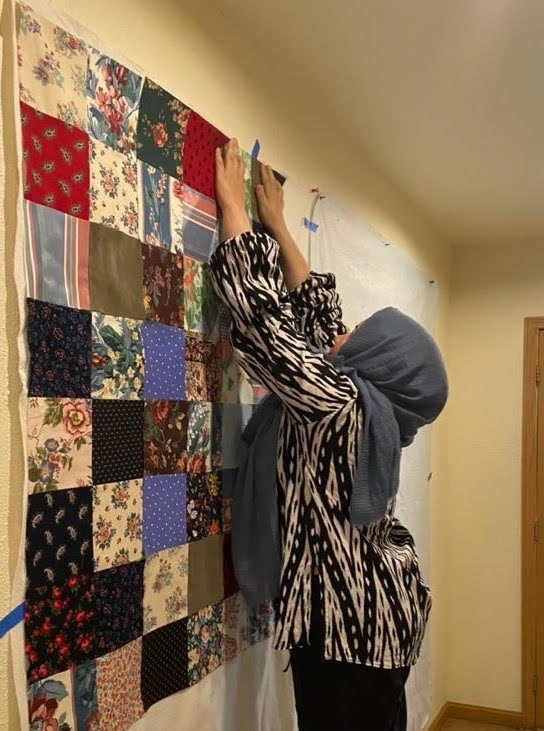
The Process
Cutting – Since the quilt was being made mostly from clothing, first the clothes needed to be deconstructed by carefully cutting around zippers and buttons and seams to preserve as much usable fabric as possible. Then 5” squares were cut, often one at a time, using the available fabric. This king-sized quilt required 288 squares!
Design – This is considered a Scrap Quilt using a wide variety of upcycled fabric. Here’s Tahira, up on a step stool, organizing all the individual squares on the design wall into an attractive arrangement. With a Scrap Quilt, there is no right or wrong — the final design depends on the creativity of the quilt artist.
Sewing – When sewing a quilt, precision cutting and sewing is very important so that seams match exactly. To help keep the project squared up, Tahira first sewed 4 squares together into a bigger square and repeated that for all the blocks. Then she sewed the 4-squared units together into 16 square blocks. And so on until everything was sewn together.
Construction – Quilts typically have 3 layers: the decorative top, the “fluffy” inside (called batting in the U.S. and “wadding” in European countries), and finally a backing (in this case, a king-sized bed sheet). Once all 3 layers were “sandwiched” together, it was time to keep the layers from shifting. This was done by tying every few inches with Perle Cotton strands through all 3 layers using a surgeon’s knot.
Final Step – The outer edge of the quilt was bound using fabric from a much-loved family floral tablecloth, the perfect wrap-up for the project!
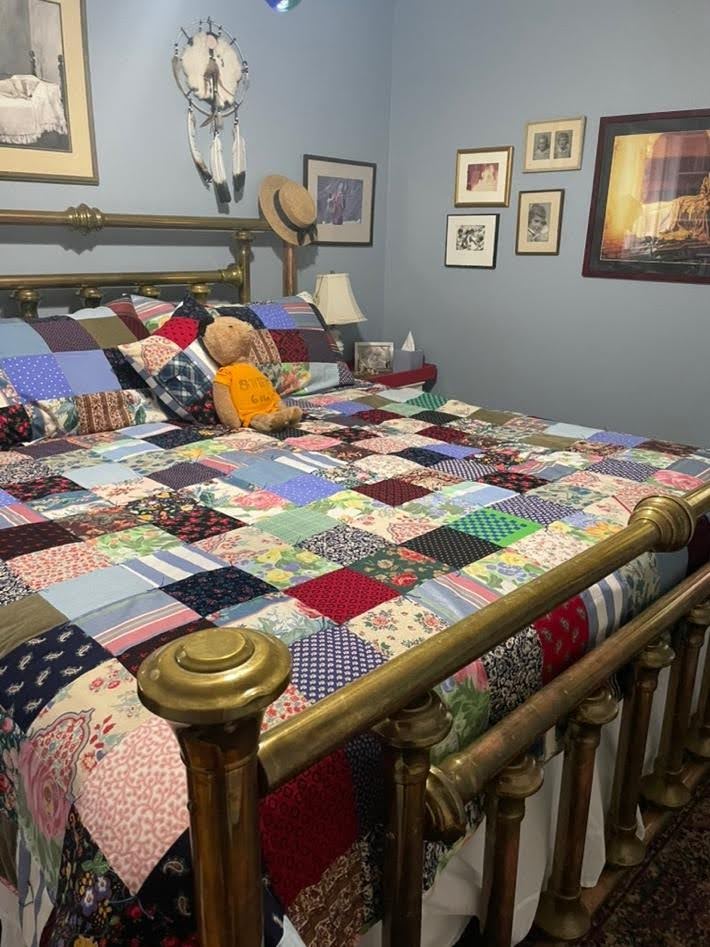
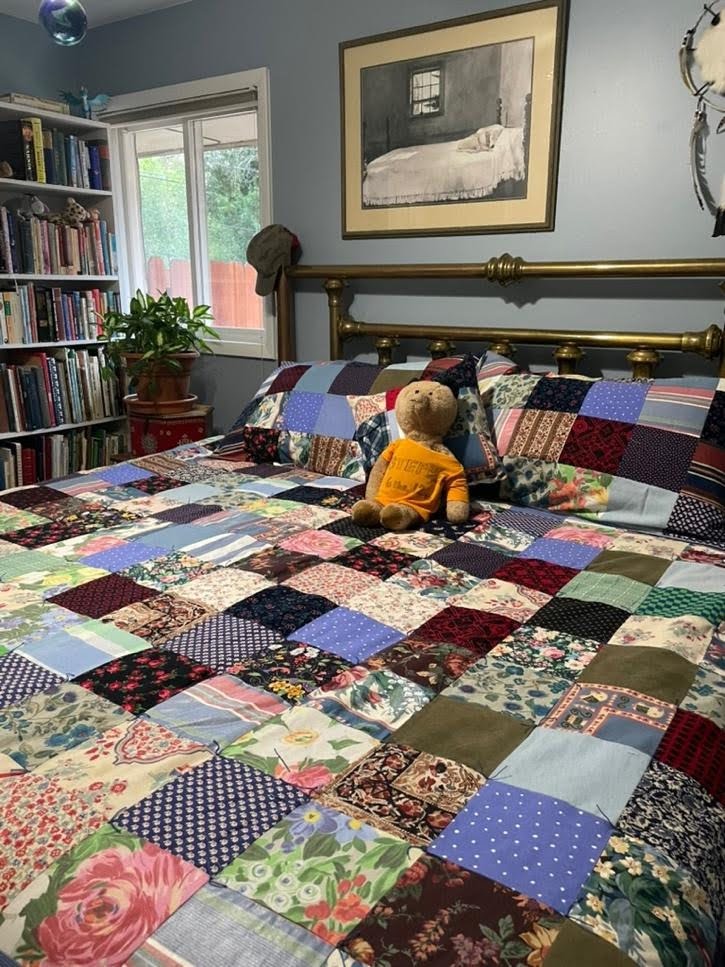
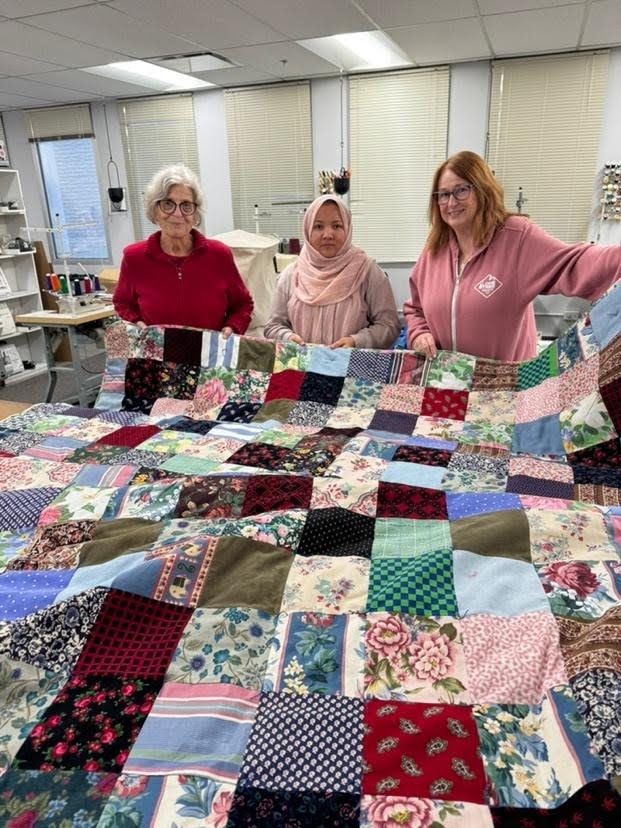
The Quilt
I went to We Made This and the quilt was literally unfolded for me. The pictures tell the story, but I want to add that I am quite sure my mother was smiling at how her taste and style have been captured and saved. I am so pleased and grateful. My children and grandchildren are all jealous and Peter was particularly impressed I had found a more than satisfactory solution.
I strongly urge you all to go visit We Made This on both the 2nd and 5th floor at 925 S. Niagara Street in Denver. Their talents and work ethic are impressive and endless, and their creativity is unmatched. You will probably find many items to buy, and you can always ask for help with something custom made. Follow them on Instagram @wemadethis. They sell products at seasonal craft sales and are stocked at Ruby’s Market on South Pearl Street.
Every time I look at the quilt, I not only think of the memories it represents, but the people who made it with love, creativity, patience and hard work. Those are words that describe my mother, so the match is perfect and meant to be.
My older son, Stephen, passed away, almost two years ago at the age of 49. His death was unexpected and devastating. That was the first time since I lost my mother that I was grateful she wasn’t here. Stephen’s very first gift was from my mother, the bear on the quilt. She put an orange shirt on the bear with Stephen’s name and weight. I think they are both pleased with how the quilt turned out.
I can never find the words to adequately thank the people at We Made This; the warmth from this quilt is both real and heartfelt.
- Visit The African Community Center and learn more about their program We Made This: https://www.acc-den.org/we-made-this
- Donate to The Ambassador Foundation’s “Pay It Forward” Scholarship In Memoriam of Stephen Noel: https://www.coloradogives.org/story/E7jfif
About Joni Noel, Director of College Advising at The Ambassador Foundation
For over 40 years, Joni Noel has been working with students and their families to help make college a reality. She found that college advising was the best career choice for her. She believes that a college education is life changing, not only for each student, but their families, friends and all the people they will meet, support, and work with over the course of their lives. Joni likes to help students find their voice and message in their applications, essays, resume and interviews, the best school match after an informed search, and the funds to make the choice possible, through scholarships and grants.